See my numbers live

Case study · Owner's dashboard on Busy

Sales were up 17.9%. So where did the money go?

A three-branch electrical goods distributor had its best year on record, and had borrowed to its limit. We built a dashboard on the Busy data they already had. It found ₹3.36 crore tied up in late payments and unsold stock.

Client
Electrical & plumbing distributor, Gujarat
Branches
3, each with its own Busy company
Built in
6 weeks · live since March 2026
Updates
Every morning at 6:00, read-only
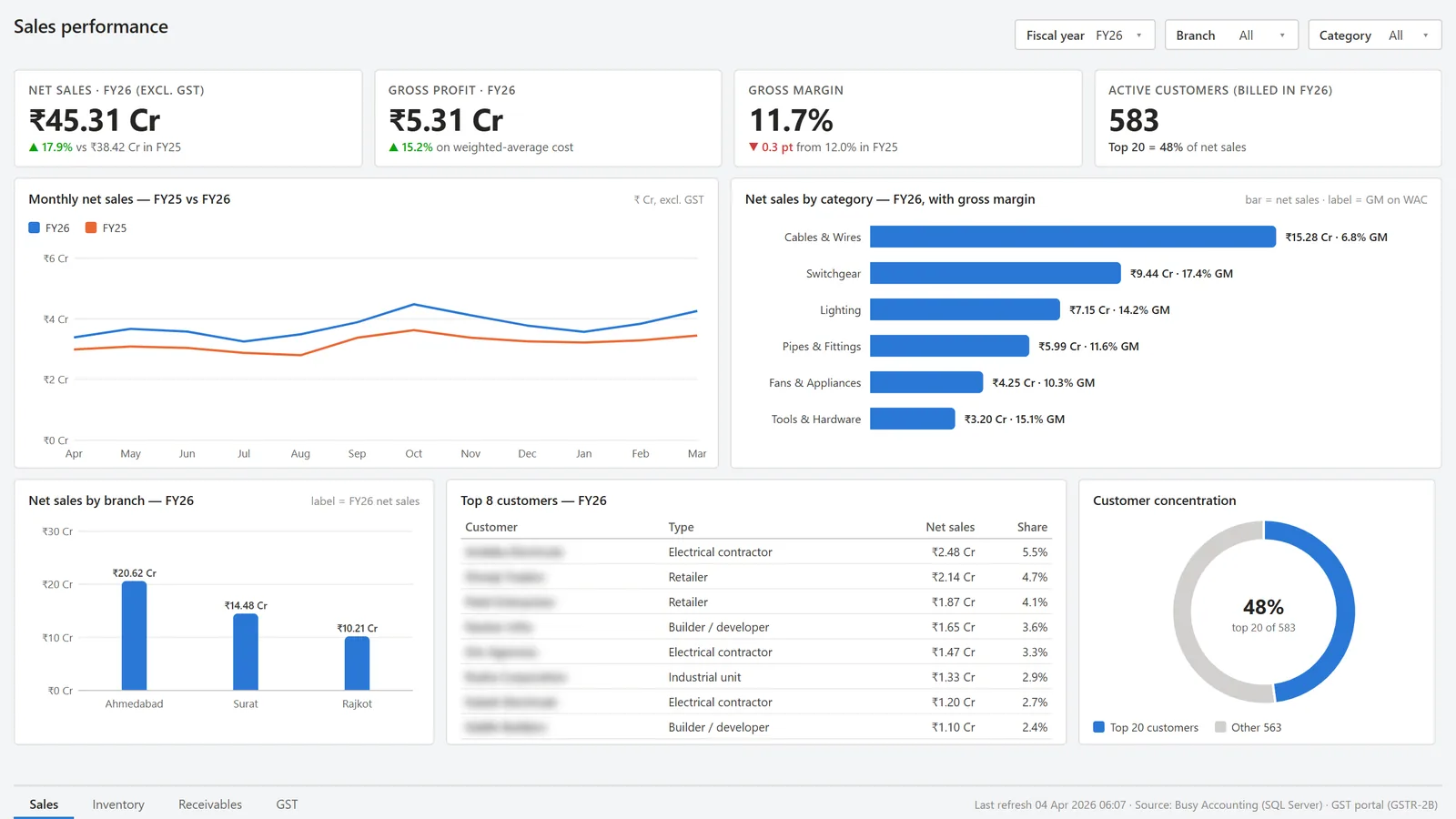
Sales dashboard: net sales, gross profit and margin cards, monthly sales against last year, sales by category with margin, sales by branch and top customers.

The sales screen the owner opens each morning. Customer names are blurred. Swipe to see the full screen.

Three months after go-live

Four numbers the owner watches now.

Days to get paid72 days61 days

23 overdue accounts put on credit hold, straight from the dashboard.

Month-end numbers9 working daysEvery morning

Three Excel workbooks retired. Nobody retypes a number.

Unsold stock₹1.59 Cr₹0.84 Cr

Moved to the branches where it sells, or sold at cost.

GST credit at risk₹43.8 L₹4.9 L

Suppliers who hadn't filed were paid only once they did.

The problem

A record year, a fully drawn loan, and nobody could say why.

Every sale, purchase and payment was already in Busy, kept by a two-person accounts team and checked by the CA each quarter. The data was there. The answer wasn't.

The month-end pack took nine working days.

Each branch printed its Busy reports and the accountant retyped the totals into one Excel file. March's numbers reached the owner in mid-April.

Three answers to "how much are we owed?"

Busy's report, the accountant's workbook and each branch's own sheet never agreed. Review meetings were spent reconciling, not deciding.

Stock was a total, not a picture.

Busy showed closing stock per branch. It didn't say which of the 1,240 items hadn't sold in six months, or which branch was holding them.

GST was filed, never checked.

Nobody compared the tax credit claimed with what suppliers had actually filed, so credit sat exposed to reversal with interest.

The answer

The loan was paying for customers who hadn't paid, and stock that wasn't selling.

Customer dues more than 90 days lateStock with no sale in 180 daysCash-credit limit, fully drawn

Almost the whole borrowing limit, costing about ₹39.4 lakh a year in interest, was funding customers who hadn't paid and stock that wasn't selling.

It was the first time sales, dues and stock had been on one screen, for one date, from one source.

The four screens

What each screen showed, and what the owner did about it.

01 · Sales

The growth was real. Most of it was low-margin.
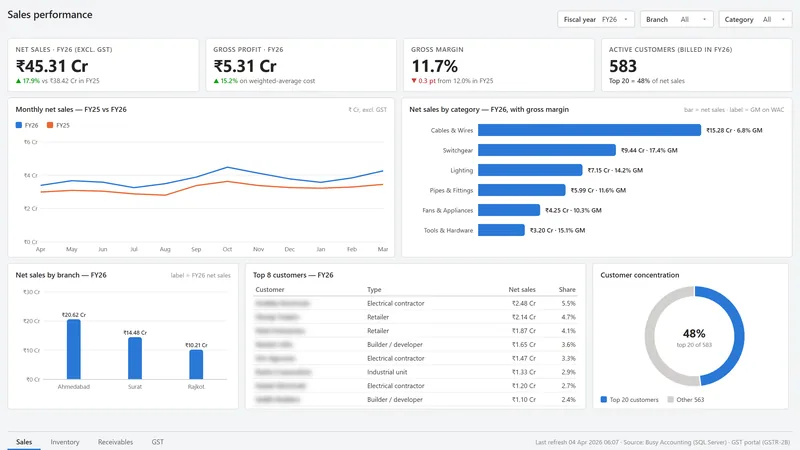
Sales screen showing cables and wires as the largest category at a 6.8% margin, against 17.4% on switchgear.

What it showed

54% of the year's growth came from cables, the thinnest-margin category: 6.8%, against 17.4% on switchgear. Cable was bought on 15-day terms and sold on 45, so every rupee of that growth used up cash.

What the owner did

Renegotiated cable supplier terms from 15 to 30 days and set a floor price for builders. The next quarter, gross profit grew 12.4% against 8.7% sales growth: the first quarter in two years where profit outgrew sales.
02 · Stock

A quarter of the items hadn't sold in six months.

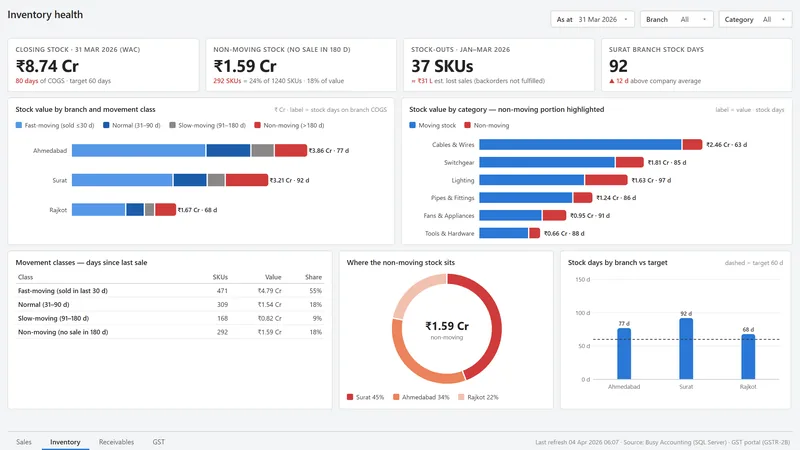
Inventory screen: closing stock, non-moving stock of 292 items, stock by branch split by how fast it sells, and stock days by branch against a 60-day target.

What it showed

292 of 1,240 items, 24%, had no sale in 180 days. 45% of that stock sat in one branch, Surat, while the same items were selling normally in Ahmedabad. Nobody knew, because each branch's stock was reported separately.

What the owner did

Moved ₹0.46 Cr of stock to the branches where it sells and sold ₹0.38 Cr at cost to a contractor. No slow-moving item is reordered now without the branch manager's approval.

03 · Dues

The slowest payers were the biggest customers.

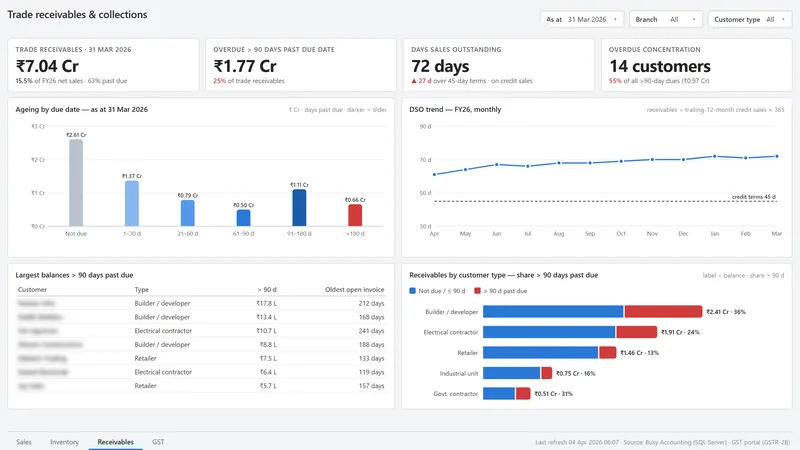
Receivables screen: dues aged by days past due, days to get paid trending up to 72 against 45-day terms, and the largest overdue balances by customer type.

What it showed

Customers were taking 72 days to pay on 45-day terms. A quarter of all dues were more than 90 days late, and 14 customers held 55% of that, several still getting fresh deliveries on credit.

What the owner did

Put 23 accounts on credit hold, straight from the overdue list, and moved the weekly collections meeting onto this screen. Days to get paid fell from 72 to 61 by June.

04 · GST

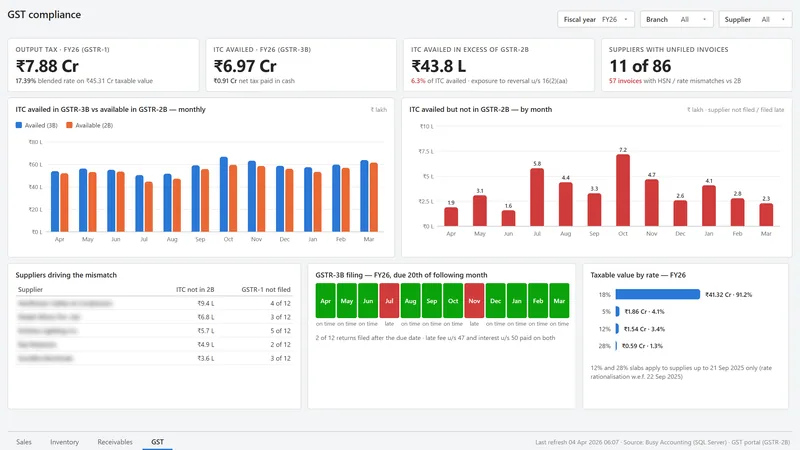
Tax credit claimed on invoices suppliers never filed.

GST screen: tax credit claimed against credit available from supplier filings by month, the suppliers causing the gap, and the monthly filing record.

What it showed

₹43.8 lakh of input tax credit had been claimed on invoices 11 suppliers hadn't filed, so it could be reversed with interest. 57 purchase invoices also had HSN or tax-rate mismatches.

What the owner did

Held payments to those 11 suppliers until they filed. ₹38.9 lakh of the credit was secured within the quarter, and a filing check was added when onboarding new suppliers.

How it was built

Read-only, and never allowed to disagree with the books.

  • Connected read-only to the Busy data. Nothing installed inside Busy, and nothing that can change an entry.
  • Three branches, three item lists and three ways of recording things merged into one set of numbers.
  • Every morning the numbers refresh, in about 6 minutes, and are checked against Busy's trial balance, to the rupee. Anything that doesn't match is flagged with a date and a reason.
  • In the first three months, 31 mismatches were flagged. Every one was cleared, in a median of 1 working day.
  • That check found ₹18 lakh of transfers between branches that had been counted as sales for years.
  • Branch managers see their own branch. The owner and the CA see everything, including on the phone before the morning call.

Built on what they already had

Busy Accounting3 branch companiesGST portal (GSTR-2B)Power BI

The accounts team kept working in Busy exactly as before. The CA now takes the quarter-end check straight from the dashboard.

Your business

See your own numbers like this.

Tell us about your business. If it's a fit, we'll show you what your dashboard would look like on your own Tally, Busy or Zoho data.

See my numbers live →

The client's name, customers, suppliers and GSTIN are withheld under NDA. Rupee amounts are rescaled from the real engagement; percentages, days and outcomes are as measured.

See your own numbers, live.

See my numbers live →